Coyote Engine Lift Plates, Stands & Handling Tools: How to Move and Hold a 5.0 Safely
The reference for handling a Ford 5.0 Coyote out of the car — why a classic carb-flange lift plate doesn't apply to a DOHC Coyote, what a Coyote lift plate or lift bracket actually bolts to, how to mount one on an engine stand, and the mock-up, cradle, and bench tools a swap or rebuild really needs.
Parts for This Guide at a Glance
Coyote swaps into older cars and trucks
Ford 5.0 Coyote owners
Ford 5.0 Coyote owners
High-boost and reliability builds
| # | Product | Owner Reviews | Availability | Best For | |
|---|---|---|---|---|---|
| 1 | — | $364.99 In Stock at Amazon | Coyote swaps into older cars and trucks | ||
| 2 | — | $242.99 In Stock at Amazon | Ford 5.0 Coyote owners | ||
| 3 | 6 | $44.99 In Stock at Amazon | Ford 5.0 Coyote owners | ||
| 4 | 12 | $169.89 In Stock at Amazon | High-boost and reliability builds |
Every Coyote project has a moment that has nothing to do with parts: the engine has to come out, go on something, and go back in. That’s where people improvise — and where a 400-plus-pound engine, a chain hooked to the wrong place, and a stand that was never rated for a long DOHC V8 turn an afternoon into an insurance claim. This is the reference for handling a Ford 5.0 Coyote out of the car: what a Coyote lift plate actually bolts to, how the engine mounts to a stand, and which mock-up and bench tools genuinely earn their space on a swap or a rebuild.
As always here: factual reference logistics and no price guesswork. Where a number varies with configuration, we say so.
Why the Coyote doesn’t handle like an old V8
If your last engine-out job was on a pushrod small block, three things have changed:
- There is no carburetor. The single most common V8 lifting tool — a plate that bolts to a carb flange and gives the chain a rated point in the middle of the engine — has nothing to attach to on a Coyote. That tool simply does not apply here.
- The intake manifold is composite, and it’s a fuel and air part, not a structural one. On a port-injected Coyote it carries the injectors and rails. It is not a lifting point, and neither are the cam covers or an accessory bracket that happens to have a convenient hole in it.
- It’s long, tall, and front-heavy with the accessory drive on. A four-cam V8 has its mass distributed differently from a pushrod engine, and the balance changes as parts come off. That’s what makes a load leveler more than a luxury — you’ll be adjusting the angle to clear a cowl or a crossmember with the engine already in the air.
Add the roughly 400–450 lb dressed weight, and the honest summary is: this engine is heavier and more awkward than the one your shop equipment was probably bought for. Verify your hoist’s rating at the boom extension you’ll actually use — hoist capacity falls sharply as the boom comes out, and the plate on the arm lists the derated numbers.
Lift plates and lift brackets: what actually bolts to a Coyote
The job of a lift plate is simple — give the chain a rated, engineered place to pull from. On a Coyote, that means one of:
- Coyote/Modular-family lift brackets or a lift plate that fasten to bolt bosses designed for the load, typically at the cylinder heads or block. This is the normal answer for a swap or a rebuild.
- Factory lifting eyes, if your engine still has them. Ford fits lifting hardware to these engines, but donor engines frequently arrive with it removed, and crate engines are packaged their own way.
Before you buy anything, look at the engine you actually own and see what’s on it and what bolt holes are free. A listing photo of someone else’s engine is not a fitment check.
Three rules that don’t bend:
- Use the correct bolts, fully threaded. Grade, diameter, and thread engagement are the whole safety margin. Bolts that bottom out short, or that only catch a few threads, are how lift points fail.
- Rig for the angle you need, not the angle you have. A load leveler lets you tip the engine nose-up or nose-down to clear the crossmember and the firewall. Trying to achieve that by shortening one chain leg on the fly is how a load swings.
- Nobody under the load. Ever. Guide the engine from the side with your hands on the block, not from under the boom.
Coyote lift plates, brackets, and the odd factory piece trade mostly used — the eBay rail above is scoped to that, and eBay listing prices are shown live so you can see what a bracket set really goes for.
Engine stands: capacity and the bolt pattern people get wrong
An engine stand holds the Coyote by its bellhousing face, which means the pattern that matters is the Ford Modular pattern — not the old small-block Ford pattern, and not whatever the universal stand’s arms happen to be sitting at. This is the single most common mounting mistake on a Coyote, and it usually surfaces as “only three of the four arms line up,” which is not a condition you proceed from.
What to check before the engine leaves the hoist:
- Rated capacity with margin. A stand’s rating assumes the load is close to the head. A long, front-heavy V8 cantilevered out on the arms loads it far harder than the number implies. Do not shop this one to the wire.
- Arm bolts: correct size, correct grade, threaded to full depth into the block. All four.
- Rotation lock engaged before you put a breaker bar on anything. The moment an engine gets one-sided — heads off, one bank stripped — it will try to spin, and it will do it fast.
- Casters on a flat floor. Stands tip sideways on gravel, thresholds, and extension cords.
A mock-up block is worth mentioning here too, because it’s the safest way to answer a lot of fit questions without ever hanging the real engine: the SoloSwap mock-up block cut for the Coyote 5.0/5.2 long block reproduces the external shape and mount geometry so you can drop it into the bay repeatedly, locate mounts, and check clearances. The swap kits by platform guide covers where that fits in the wider swap sequence — it’s most valuable on a universal or fabricated swap, and least necessary when a platform kit already has engineered bolt-in perches.
Cradles and docks: where the engine lives between sessions
A stand is an assembly tool. A cradle or engine dock is a storage and transport tool — it supports the long block low and stable on the floor, takes far less room than a stand’s footprint, and doesn’t leave the engine hanging off four bolts for six months while you’re saving for the next stage.
If your build is a series of weekends rather than one long weekend, something like this BlockDock engine cradle storage stand for the Coyote 5.0 is the more sensible home for a long block between sessions — and it makes moving the engine around a shop a one-person job instead of a hoist job. Cover the intake and exhaust openings while it sits; an open port is an invitation to everything that falls off a shelf.
The bench tools a Coyote build actually requires
Once the engine is on a stand, the Coyote’s specific demands take over. These are the tools that decide whether the reassembly is right, not just done:
- A ring compressor sized to the bore. The Coyote’s bore is 92.2 mm — about 3.63 in — across Gen 1 through Gen 3, which is exactly why a Coyote-specific tool like this 3.630-bore piston ring compressor exists. A tapered sleeve cut to the bore installs a modern low-tension ring pack far more reliably than an adjustable band you’re guessing at. The bore figure comes from the engine specs reference, which is where to confirm it for your generation.
- A generation-correct timing tool kit. The four-cam Ti-VCT valvetrain has to be held and the crank positioned so the chains, guides, and phasers go back in time — this is not a job you eyeball. Timing tools are sold to year ranges for a real reason: this engine timing tool kit built for the 2018–2023 Gen 3 5.0 is specified to that generation, and buying to your engine’s year range is the same discipline that governs intake manifold fitment.
- A calibrated torque wrench with an angle gauge. The Coyote is full of torque-to-yield and torque-plus-angle fasteners — head bolts, mains, rod caps, cam caps, flywheel bolts. An angle gauge isn’t optional equipment on this engine.
- A factory service manual with the complete torque tables. The numbers vary by fastener and by year, and they are not the place to work from memory or a forum post. Service manuals are a staple of the used market.
The rebuild kit guide covers the parts side of that same job, and the head studs and gaskets guide covers what changes when boost is the goal.
Do the engine-out jobs while it’s out
The engine on a stand or a cradle is the best access you will ever have to it. A short list worth clearing before it goes back in:
- Rear main seal and the flywheel/flexplate face — trivial now, an engine-out job later.
- The accessory drive. With nothing in the way, the belt system is as easy as it gets; a complete all-inclusive serpentine system for the Coyote 5.0 is one of the parts people wish they’d sorted on the stand rather than in a finished bay, especially on a swap where the factory routing doesn’t fit the chassis anyway.
- Known generation-specific weak points. If your engine is one of the years with a documented issue, fix it now — the common Coyote problems by generation page maps each one to the part that solves it.
- Wear items you’d otherwise pay labor for twice — see the maintenance parts guide.
- Wiring, if this is a swap. Route and mock the harness with the engine accessible; the swap wiring guide explains why doing it after the engine is in is the harder path.
The short version
- A carb-flange lift plate does not apply to a Coyote. Lift from bolted, engineered hard points — brackets or a Coyote/Modular lift plate — never the composite intake, cam covers, or an accessory bracket.
- Plan for roughly 400–450 lb dressed, and check your hoist rating at the boom extension you’ll use.
- Engine stands mount to the Ford Modular bellhousing pattern. Capacity with margin, correct bolts to full depth, rotation lock on.
- A mock-up block replaces repeated heavy test-fits on a fabricated swap; a cradle is the better long-term home for a long block.
- Size the ring compressor to the 3.63 in bore, buy the timing tools to your engine’s year range, and torque with an angle gauge against real factory tables.
Where to buy
- New tools and handling gear: Amazon Automotive — the featured tools below cover the Coyote-specific pieces (mock-up block, cradle, bore-sized ring compressor, generation-specific timing kit).
- Used lift plates, brackets, stand adapters, load levelers, and service manuals: eBay Motors, using the buttons above — this is exactly the category where used gear is as good as new, and eBay shows the live listing price so you can judge it yourself.
One last check before you buy any of it: confirm the bolt pattern and the year range against the engine you actually have, not against the engine in the listing photo. That rule holds for a stand adapter the same way it holds for an intake manifold.
Shopping used or OEM? Try eBay Motors
Live listings for the parts covered in this guide — prices set by the seller.
Recommended Parts for This Guide
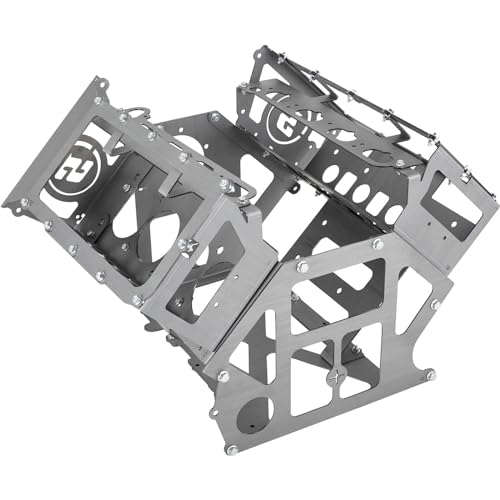
Engine Mock Up Block For Ford Coyote 5.0L 5.2L SoloSwap Long Block | Designed for accurate engine placement and mount fabrication
Engine Mock Up Block For Ford Coyote 5.0L 5.2L SoloSwap Long Block | Designed for accurate engine placement and mount fabrication. Coyote swap hardware — mounts, harnesses, and control-pack parts for dropping a Ford 5.0 Coyote V8 into an older car or truck.
- Simplifies the Coyote swap
- Mounts, harness & control pack

BlockDock™ Compatible with Ford Coyote 5.0 Engine Cradle Storage Stand
BlockDock™ Compatible with Ford Coyote 5.0 Engine Cradle Storage Stand. A quality upgrade or replacement part for your Ford 5.0 Coyote V8.
- Fits Ford 5.0 Coyote
- Quality build

BTR Coyote 5.0 3.630 Bore Piston Ring Compressor Tool 302 Modular 5.0L V-8 Mustang Brian Tooley
6 owner reviews
BTR Coyote 5.0 3.630 Bore Piston Ring Compressor Tool 302 Modular 5.0L V-8 Mustang Brian Tooley. A quality upgrade or replacement part for your Ford 5.0 Coyote V8.
- Fits Ford 5.0 Coyote
- Quality build

DPTOOL Engine Timing Tool Kit for Ford Mustang F150 5.0L Coyote 2018-2023 | for Ford Gen 3 5.0L Coyote V8 Engine with Valve Spring Compressor Tool Camshaft Holding Tool Crankshaft Positioning Tool
12 owner reviews
DPTOOL Engine Timing Tool Kit Compatible with Ford Mustang F150 5.0L Coyote 2018-2023, for Third Generation 5.0L Coyote Engine with Valve Spring Compressor Tool Camshaft Holding Tool. Head studs and sealing hardware — the foundation of a reliable, high-boost forced-induction Coyote build.
- Seals high-boost builds
- ARP-grade hardware
Frequently Asked Questions
What is a Coyote engine lift plate?
Can I use a normal lift plate on a Coyote 5.0?
How much does a Coyote 5.0 engine weigh?
What engine stand do I need for a Coyote?
Do I need a mock-up block for a Coyote swap?
What size ring compressor does a Coyote take?
Can I store a Coyote on an engine stand long term?
Keep reading in the Coyote reference library
Coyote parts are sold by generation and platform far more often than the listings admit. These are the pages that answer whatever this one sends you asking next.
Coyote Swap Kits by Platform
What a complete kit includes for Fox Body, SN95, S197, trucks and universal — mounts and oil pan must match.
Coyote 5.0 Rebuild Kit Guide
What's in a kit by tier, Gen 1/2/3 differences, and reseal vs rebuild vs a used long block.
Coyote Swap Guide
The end-to-end process: donor engine, mounting, wiring, cooling, fuel and exhaust.
Coyote Engine Parts Diagram & Reference
Every system on the engine mapped in one place — the hub the rest of these pages hang off.
Shop the parts this guide covers
Or browse the full guide library, the ranked top lists, and all Coyote part categories.